I’ve written this so the people around me, and anyone who can help, can see the whole picture in one place. It goes in order: what happened, what I’ve done to get help, what I’ve been feeling, and what I think it all means. The scans, the tests and my reading of them are on four companion pages, listed below.
It covers my mental health too. That’s part of the same story, and some people close to me have wondered whether I have bipolar disorder. What my evaluations actually found is below.
I’ve since put every record I have side by side with this analysis, with my clinicians’ and practices’ names left out: What My Records Say.
How I feel
Over the past year and a half, what I’ve felt most is that people don’t understand. I’ve tried to explain it to the people closest to me and to the professionals I’ve seen, and I keep coming away feeling unheard and alone.
Work is a big part of this, so here’s how I got here.
Out of college I worked as a verification and validation test engineer at a medical device R&D company, where I’d also interned. I wanted to move into controls. On top of my own work, measuring how compliance in the system affected syringe pump performance, I learned Kalman filters and PID tuning from our controls engineer, and I told our project manager that’s where I wanted to go. They hired a classmate of mine with a master’s degree instead.
That fall, in 2022, a software company cold-called me on LinkedIn because of my CFD background. It felt like a lifeline. I pitched myself with a fluid-simulation side project of mine to show that I cared about CFD, understood it, and could use automation to get more done. Then I was put on feature testing in the graphics window: do the color maps make sense, does the font get bigger when you press plus. I didn’t study mechanical engineering for that.
So I proved myself in the work I wanted, one area at a time. I took over two regression jobs that had worn down the engineers before me, automated them, and doubled how often they ran. I built features for the team’s Django testing portal, having never done web development. I worked my way into developing the Python test runner itself. My reviews said all of it.
I do my best work where what the business needs meets what I care about, with trust and room to decide. Being tracked hour by hour wears me down. I keep giving, and it feels like everyone keeps taking.
Most of my coworkers were on work visas, overworked and afraid to speak up. I spoke up, and nobody listened. Out of that frustration I broke the company’s rules, and in October 2024 I was let go. That part is on me.
In November 2024 I joined a small consultancy where I’m trusted, and I treated that work as my lifeline. I went to the gym two hours a day, and if I’m honest, a lot of it was me punishing myself, out of hate and guilt. On 20 April 2025 I rounded my back on a Romanian deadlift. The timeline below starts there.
So I feel like I did this to myself, and that the world did this to me. I’m working on forgiving both.
I know I go down rabbit holes, and this page is one. But I’ve been consistent for a year and a half about what I feel and where, and I know I’m sane. That’s why the tests are all here, on this page and the four that go with it.
My therapist thinks medication will help. I think rest, and stepping away from my ego and from overloading myself, is what I need. I’ve agreed to see a psychiatrist and work it out with them.
I need help from people. Whoever can help me should know what I’ve been through.
What I’ve done to get help
I haven’t been sitting still. In the eighteen months since the injury I’ve seen at least fifteen clinicians and practices. I’ve driven two hours each way for most of the care that has actually helped, and done a lot of the work myself.
-
April–May 2025: I didn’t have health insurance when I got hurt, so I rested and rehabbed myself.
-
June 2025: I learned to scull on the Connecticut River in a back brace.
-
August 2025: physical therapy, two visits before I moved for my PhD.
-
Fall 2025: a chiropractor, an orthodontist, and a dentist who made me a night guard for my jaw.
-
November 2025: I found a speech-language pathologist in Massachusetts on my own. She was the first to find the tongue tie.
-
January–March 2026: therapy for anxiety. A neck MRI, an ENT, and a second speech-language pathologist.
-
February–April 2026: an airway-focused dentist and a 3D scan of my airway, and retina testing in Boston.
-
May–September 2026: four months of physical therapy with a PRI-certified therapist who works from Bill Hartman’s model, a two-hour drive each way.
-
2026:
- myofunctional therapy by video;
- two home sleep tests;
- a CPAP I ordered long ago that only arrived after I chased the company to ship it.
-
September–October 2026:
- MRIs of my brain, neck and mid-back;
- a nerve test and blood work;
- a second ENT, with a camera exam of my throat;
- a psychiatric evaluation;
- therapy again.
A lumbar MRI and a swallow study are booked.
-
19 October 2026: I put it in writing. I asked my hospital to correct the errors in my chart and to send me any recordings and transcripts its AI note-taking tool made of my October visits. I also wrote to Patient Relations asking for one person to coordinate my care.
-
On my own:
- I built a tool to measure my posture from my PT photos.
- I studied 51 videos from three schools of posture teaching.
- I gathered every record I could get, and I keep a written account so nothing gets lost between offices.
Where the system hasn’t helped
This is my experience, and my records back it up:
- When I got hurt I had no insurance, so the first months of care were mine to figure out.
- I hurt my lower back. My neck was scanned in January, and my brain, neck and mid-back in September. Since I got insurance in August 2025, I’ve told clinicians again and again that I hurt my back, and asked for an MRI of it. The first one is booked for late October 2026, eighteen months after the injury, and it was ordered only after new bladder symptoms appeared.
- In January an ENT wrote that my tongue moved normally. Four days later a speech-language pathologist at the same hospital found it restricted in every direction. She recommended I see a surgeon there who releases tongue ties. That referral never came.
- The tongue tie itself hasn’t been taken seriously. Both ENT notes put “posterior” in quotation marks, and one ENT told me he wasn’t familiar with a posterior tongue tie at all. My myofunctional therapist works with a lot of tongues, and she says mine is one of the most restricted she’s ever seen. In his talk on airway-centred dentistry, Hallinan says a severe posterior tie “might prevent their body from getting neutral at all” (Airway Centered Dentistry, 7:39).
- The specialist I was sent to in October for my jaw wrote in his own note that jaw problems aren’t his area.
- In October I left an ENT visit early because I didn’t feel he was interested in hearing me. His note reads more like commentary than findings. A nurse saw me lying on the waiting-room floor with my feet up on a chair, and the note passes that on without asking why; I lie down to take the load off my back. It calls it “interesting and notable” that I’ve had care in several places and by video, when I was a student two hours away. It says “we will see whether the patient carries through with the plan.” And it twice treats the nasal valve collapse on my referral as if it came from a home sleep study, when it came from my April 2026 airway scan, which the note never mentions.
- Clinicians disagree about my tongue tie and my nose. Instead of weighing each other’s findings, each specialist has gone with their own, and nobody has been responsible for reconciling them. My problems run across my jaw, tongue, airway, neck and posture. My body is connected; my care hasn’t been.
- My chart lists three different primary care clinicians. It also has errors that misstate my history, including a line that reads as if I have bipolar disorder myself rather than a family history of it. On 19 October I filed a formal request to correct them. One note was revised after I asked, and other errors remain.
- One office didn’t return five calls.
- Most of the care that has actually helped has meant a two-hour drive each way, with a back and neck that flare when I sit.
Through all of it, I’ve been the one carrying my care from one office to the next. The details are in What My Records Say.
Timeline
What I’ve been feeling
- Sciatica: symptoms down my right side since the injury.
- My right foot: weakness in my ankle and toes, and less feeling in my heel.
- My right hand: odd sensations in my fingertips, with peeling skin.
- Bladder and genitals: more dribbling after I urinate, and tingling at the tip of my penis. My doctor knows, and a lumbar MRI is scheduled for the lower spine, which my September MRIs didn’t reach.
- My neck: my main concern right now.
- My jaw: temporomandibular (TMJ) symptoms since October 2025.
- My arm: symptoms like thoracic outlet syndrome since fall 2025.
- Swallowing: difficult and painful when I’m reclined with my neck extended. I feel it only on the right, around the level of the hyoid and thyroid cartilage.
- Sensing my torso: I have a hard time sensing where my torso is in space.
- My nervous system: ongoing deep discomfort, and what feels like an unstable nervous system, despite how long I’ve been working on it.
- Weight: I’ve lost about 20 lb in a few months, from 160–165 to 147–150, even though I’m eating high-calorie food. I’m keeping a food journal.
- Sleep: about 6½–7 hours a night, broken up by nightmares, twitching and frequent waking. I’ve had two home sleep apnea tests and started a CPAP in mid-October 2026. It’s early, but it seems to help.
- Anxiety and mood: chronic anxiety and racing thoughts, and irritability that flares around conflict. People close to me see my mood shift from one day to the next: some days I’m fine, and on others I talk fast, jump between topics and snap at people. I’ve had panic attacks, the last a few months ago.
Long stretches of sitting still, long drives, and anything that tips my head back make it worse.
Blood work
On 13 October 2026 my doctor ordered screening labs to look for a cause of the weight loss. Thyroid (TSH 2.17), electrolytes, kidney and liver function, vitamin D, immune proteins and ceruloplasmin were normal, and Lyme and syphilis tests were negative. BUN, a kidney marker, was a hair above range (23), and B12 came back high, likely from my daily multivitamin. My doctor called the weight loss “likely multifactorial with anxiety as a major contributor.”
Psychiatric evaluation
On 14 October 2026, after an argument at home, I went to the emergency department for a psychiatric evaluation. I went voluntarily, for my family’s sake. A psychiatry resident interviewed me for 90 minutes, with my father and my girlfriend there. What the evaluation recorded:
- Thinking: “linear, logical, and organized,” with memory, orientation and attention intact and fund of knowledge above average.
- Insight and judgment: both good.
- Perception: no hallucinations, delusions or paranoia.
- Speech: normal rate and rhythm in the interview. My family described fast, pressured speech at other times.
- Mania: bipolar disorder runs in my family, but the evaluation concluded that I’m “without present or past symptoms consistent with mania or hypomania.”
- Screening questionnaires: negative on one (the MDQ), positive on the other (the HCL-32, a hypomania checklist), with symptoms lasting about a day at a time.
An emergency visit can’t settle a diagnosis, and the note says so. It lists possible contributors to my mood swings: anxiety, past trauma, personality, the pile-up of stressors, and possibly cyclothymia, a milder, long-running mood pattern. That’s the question I want outpatient psychiatry to answer. I was sent home the same day.
Two days later, on 16 October, I had an intake with a therapist, and he saw something different. In his office I had elevated energy and pressured speech, and my mood read as anxious, low and hypomanic all at once. My thinking was logical and goal-directed, though it sometimes went off on tangents. He found no delusions or hallucinations, and my insight was intact. My anxiety score had gone from mild earlier in the year (5 to 9 on the GAD-7) to severe (15) in September. He’s referred me to psychiatry for a diagnosis and to discuss mood stabilizers.
My own account of those two visits: I’ve been consistent about what I’m saying, and a close friend who knows me well, and who I confide in, would say the same. I do get elevated energy when I talk about some topics, the way anyone does about something they care about. If that’s what counts as hypomania, then sure, but that isn’t my experience of it. I’ve read a lot, and I have my own perspective that makes sense to me. The clinicians I’ve been working with haven’t understood it, even though I’ve been cooperative and calm. After a year and a half of a back injury, everything that’s cascaded from it, and strain in my personal life and with the people I love, my patience may be running thin.
So two careful evaluations, two days apart, disagree on hypomania. I’m putting both here because the disagreement is exactly what psychiatry needs to settle.
I’ve had an anxiety diagnosis since December 2025. I’ve held off on antidepressants because of the family history of bipolar disorder, and I want to make that call with a psychiatrist.
The details
The scans, the measurements and my reading of them have their own pages:
- My Airway, Tongue and Jaw
- My Spine and Brain
- How My Body Moves
- Three Ways to Read My Case
- My Deep Front Line
What I think is going on
- Nothing dangerous has shown up. No cord or nerve compression in my neck or mid-back, nothing worrying on the brain MRI, and a normal nerve test (EMG). The lumbar MRI is still to come.
- My mind has been checked, too. Two evaluations two days apart found logical thinking, intact insight and no psychosis. The emergency department saw no mania or hypomania; my therapist saw signs of hypomania. Severe anxiety is the constant. Psychiatry will settle the rest.
- The problem is how my body is organized, not broken structure. I’m compressed with very little rotation anywhere, my left hip is held turned in, and my upper neck turns under my head when I’m upright, far more than when I’m lying down.
- Independent tests agree. My PT’s chessboard, my standing photos, the CBCT and the MRIs were done by different people, with different tools, months apart, and they describe the same body.
- The likely drivers are ordinary, and they add up: one strong eye since childhood, years of right-sided sport in goal, an injury, a lot of driving and sitting, and the stress, lost sleep and lost weight of 2026.
What I’m doing about it
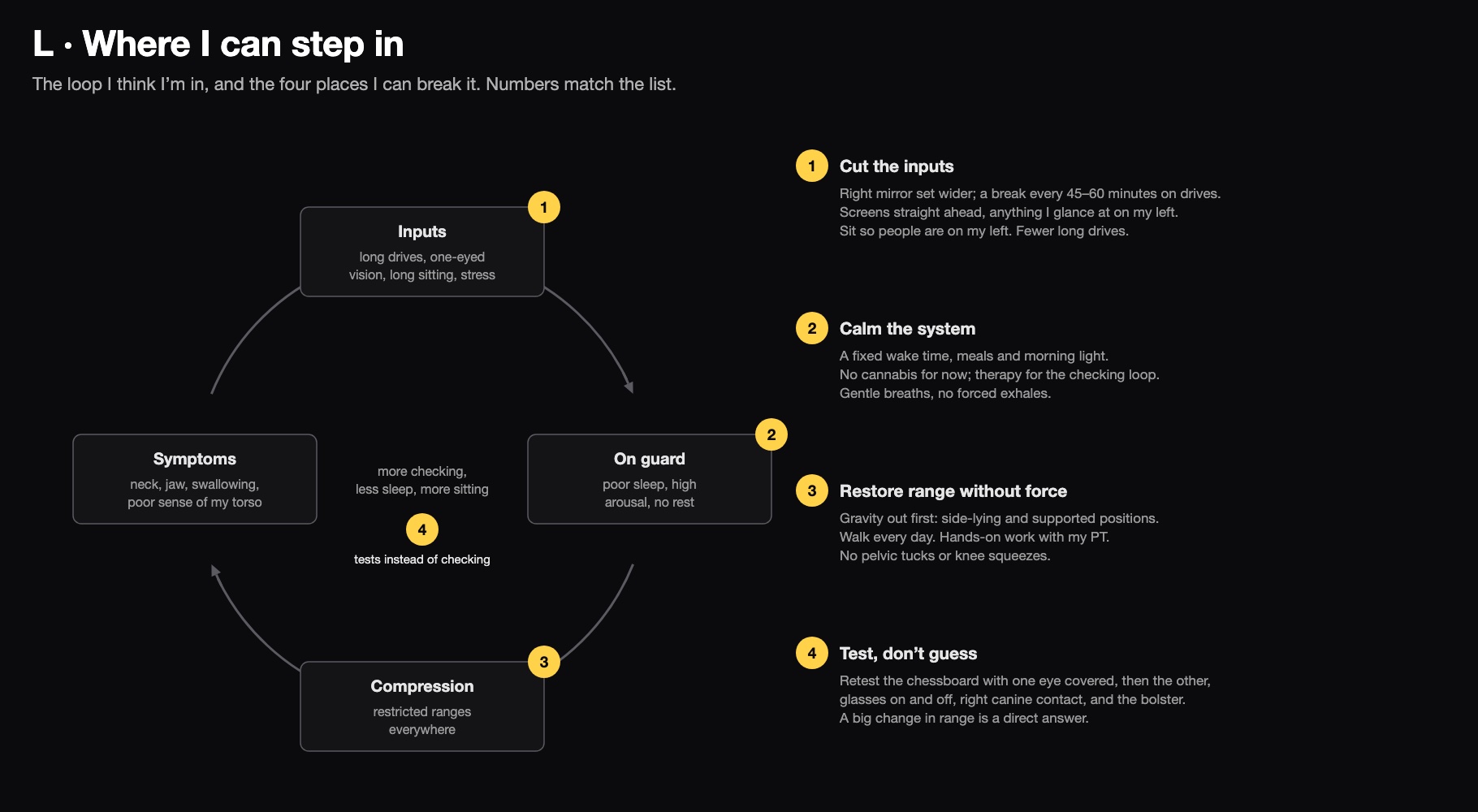
The neck turn is downstream of everything else, so I’m not working on it directly. Every lens I’ve read agrees on that, and so does PRI’s own order: pelvis and ribs first, neck last.
- Leaving my neck alone. No chin tucks, no cracking it, no forcing it to turn the other way.
- Getting tested in person. I’m asking a PRI-trained PT for the canine-contact test, a check of whether glasses on or off changes my neck rotation, and a comparison of my rotation sitting, standing and lying down.
- Cutting what feeds the turn. I’m setting my right mirror wider, stopping every 45–60 minutes on long drives, keeping screens straight ahead with anything I glance at often on my left, and sitting so people are on my left. I’m also avoiding reclining with my head tipped back, which is also my swallowing trigger.
- Walking every day. Walking swings the trunk and pelvis both ways thousands of times without my having to think about it.
- Taking gravity out on bad days. I lie on my side or with my back supported, and breathe gently without forcing the exhale.
- Getting help for my mind. I’m seeing a therapist, I’ve been referred to psychiatry, I take hydroxyzine as needed for anxiety, and I’m working with sleep medicine.
- The basics. Sleep, food, strength and a steady daily routine.
What’s next
Next up: a lumbar MRI and a swallow study, answers to my three requests by mid-November, a new physical therapy evaluation, starting therapy and outpatient psychiatry, the questions for my care team, and the unglamorous basics of sleeping, eating and getting my strength back.